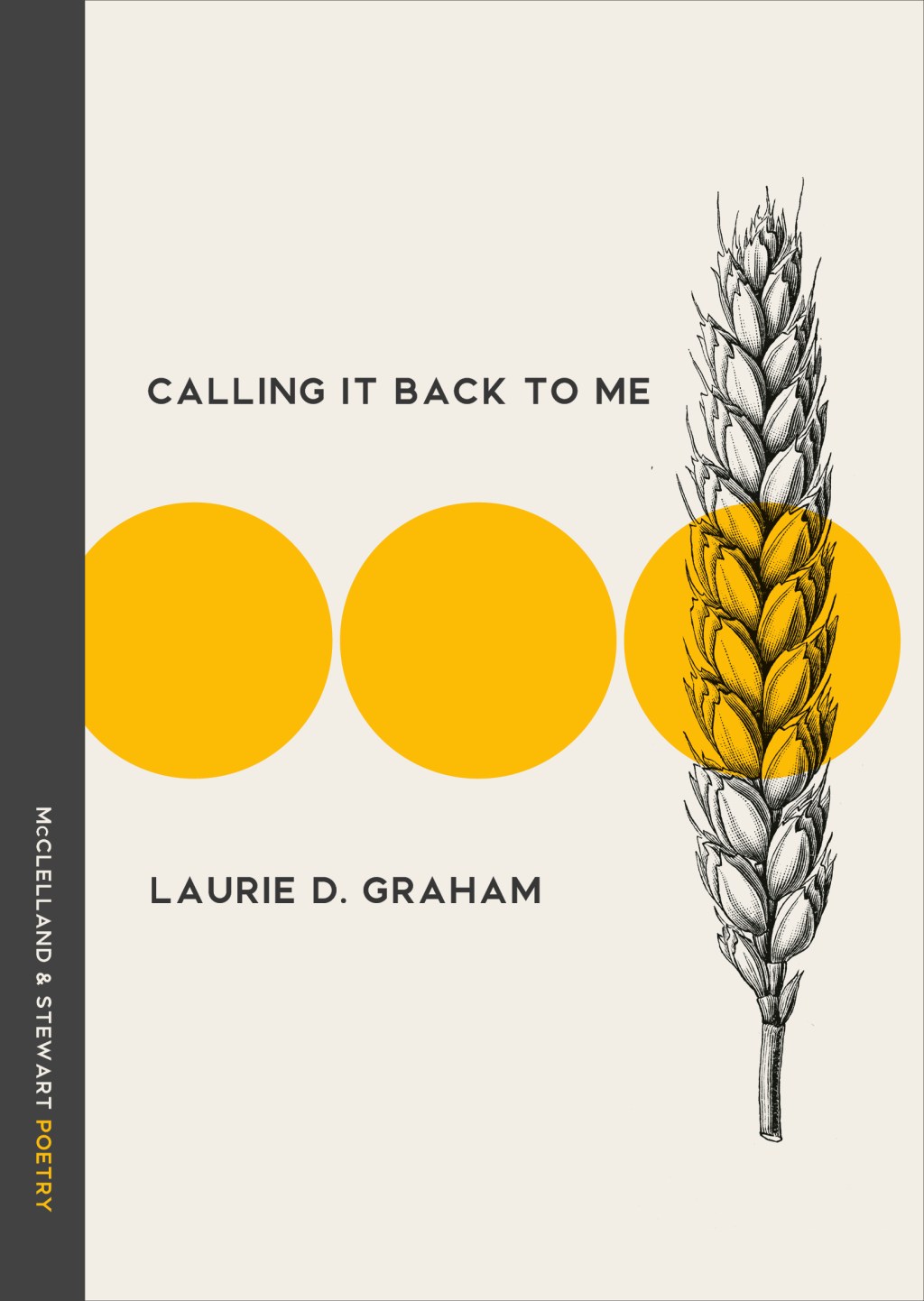
“‘I miss the lives / I have not lived,’ writes Laurie Graham and an unrelenting, tender, brave historical introspection begins. She looks especially for the four great-grandmothers, those homestead lives, and is struck repeatedly by their unknowability which over time has become what she is, the same gait, same brow, same don’t-cross-me streak. The trail to the dead is snow-packed and often disappears entirely. This is a moving book of desire, identity, homage, and remorse.” —Tim Lilburn
“Calling It Back to Me announces a call-and-response suite of poems: the call from ‘erased’ names to those that are ‘retained,’ the call from an ancestral genealogy to the stuttering syllables at a grandfather’s grave, the call from a poet’s singular voice to all the others it is her burden to carry . . . . In the epic sequence, ‘Toward an Origin Story,’ Graham comes to grips with the settler’s paradox: a ‘homeplace’ she never knew, but instead a homestead—‘every arable, pilfered inch’—on ceded Indigenous Territory. The poem asks, What is origin, original? What is mine, not mine? now that the great-grandchildren have fled the dried-up sloughs, ‘the soil long spent,’ for the cities.” —Myrna Kostash
“In Calling It Back to Me, Laurie D. Graham composes a resonant genealogy ‘suspicious of narrative’; a genealogy of ‘vanished / names’; of ‘churned grasses’ and ‘low poplars yellowing’; of ‘vernaculars that died.’ Her strikingly clear and deeply moving poems reveal a pose of brave and persistent witness that might engender in readers a deeper understanding of their own homeplaces.” —Sheri Benning
A poet’s clear-eyed witnessing of familial history, this is the most personal collection yet from two-time Trillium Book Award finalist Laurie D. Graham.
In these searching, spare, and resonant poems, Laurie D. Graham traces the story of her great-grandparents’ lives before and after they left their homelands and settled on this continent, striving to understand how she came to be here and writing the act of colonization as it exists in her own family history. This collection’s fractured lines, time-weathered yet alive with detail, reflect a family’s knowledge broken by global immigration and memory loss, both individual and collective. The result is a courageous reckoning with the legacy of leaving home.
With tender curiosity and a determination to bear unflinching witness, Calling It Back to Me asks: When language and memory are so tenuous, what is it that gets passed down between generations?
 Laurie D. Graham